
NewsWPLG Local 10 – Main FeedSeptember 10, 2026Miami-Dade County
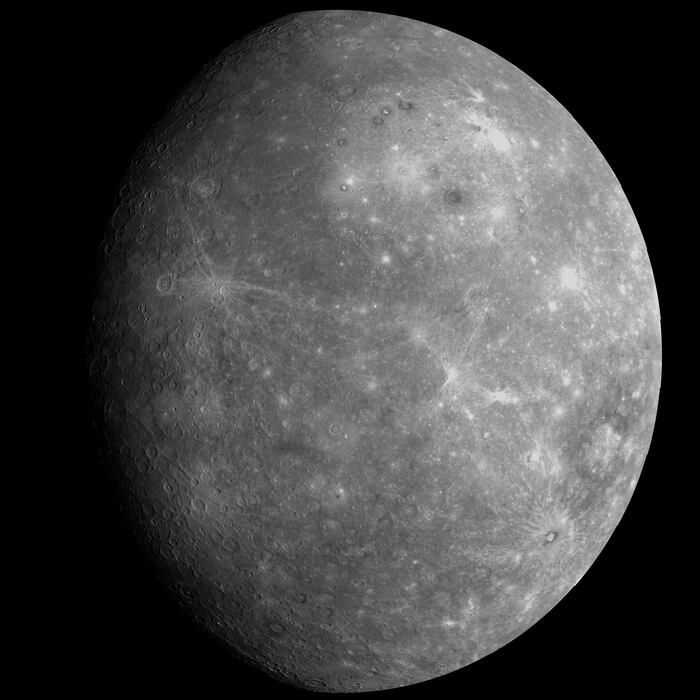
German Aerospace Center study reports Mercury is shrinking faster than previously believed
Photo: WPLG Local 10 – Main Feed
A new study reports that Mercury's shrinkage may be 30% greater than previously believed, resulting in a loss in diameter of up to 14 miles. Researchers attribute the contraction to the cooling and contracting of the planet's oversized hot iron core, mantle, and crust since its formation.
Read the full story at WPLG Local 10 – Main FeedWhy It Matters
This scientific finding updates estimates of Mercury's planetary contraction by up to 14 miles in diameter, providing new insights into the planet's thermal history and evolution.
Key Facts
- A new study indicates Mercury's shrinkage may be 30% greater than previously believed.
- The estimated loss in Mercury's diameter is as much as 14 miles (23 kilometers).
- Mercury has a total diameter of barely 3,000 miles (4,900 kilometers).
- Researchers suggest Mercury's rough surface, shaped by impact debris, may have hidden the true extent of contraction wrinkles.
- BepiColombo, a linked European and Japanese spacecraft, is expected to enter orbit around Mercury in November.
- Mercury has been shrinking continuously since its formation 4.5 billion years ago due to internal cooling and contracting of its hot iron core, mantle, and crust.
- Previous estimates were based largely on measurements from NASA's Messenger spacecraft in the 2010s.
- Only two spacecraft have ever visited Mercury prior to BepiColombo: NASA's Mariner 10 in the 1970s and Messenger in the 2010s.
Who's Mentioned
OrganizationBepiColombo“A pair of European and Japanese spacecraft advancing toward Mercury.”OrganizationGerman Aerospace Center’s Institute of Space Research“Researchers from this institute reported the new study findings on Mercury.”OrganizationMessenger“NASA spacecraft that provided prior measurements in the 2010s.”OrganizationNASA“Conducted measurements with the Messenger spacecraft in the 2010s and Mariner 10”PersonGaku Nishiyama“Study lead author and participant in the space mission.”OrganizationGeophysical Research Letters“The scientific journal where the findings appear.”OrganizationMariner 10“NASA spacecraft that visited Mercury in the 1970s.”OrganizationHokkaido University“University affiliated with lead author Gaku Nishiyama.”OrganizationAP Fund for Journalism“Provides financial support for The Associated Press' health and science coverage”