POLISCOPE
Back to feed
NewsPasadena NowOctober 27, 2026Los Angeles County

Caltech to Lead NASA's UVEX Mission to Create First Deep Ultraviolet All-Sky Maps by 2031

Photo: Pasadena Now

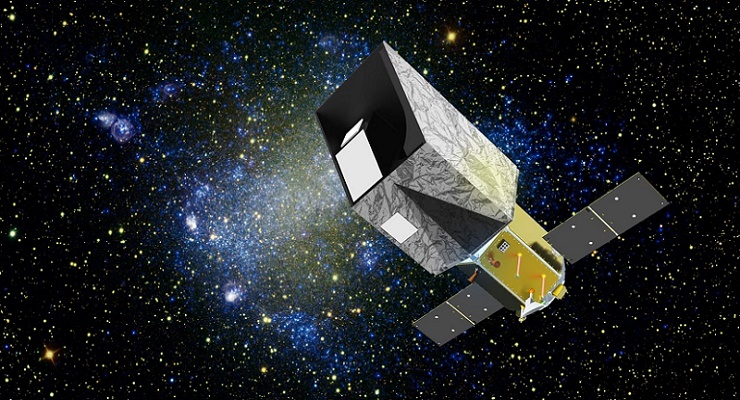
NASA has committed to launching the Caltech-led Ultraviolet Explorer (UVEX) space telescope mission by 2031 to create the first deep all-sky maps in ultraviolet light and identify millions of tiny galaxies. The mission will feature advanced silicon-based ultraviolet detectors built through a collaboration involving Caltech, UC Berkeley, NASA's Jet Propulsion Laboratory, and Northrop Grumman. UVEX will be up to 100 times more sensitive than its predecessor, Galaxy Evolution Explorer (GALEX), and will rapidly track dynamic cosmic events such as supernovae and neutron-star mergers.

Read the full story at Pasadena Now

Why It Matters

The mission deploys newly developed ultraviolet detector technology derived from smartphone camera sensors to capture cosmic phenomena invisible to human eyes, expanding the global astronomical data archive over the next decade.

Key Facts

  • NASA committed to launching the Caltech-led Ultraviolet Explorer (UVEX) space telescope mission by 2031.
  • UVEX will create the first deep all-sky maps in ultraviolet light and identify millions of small galaxies.
  • The space telescope will be up to 100 times more sensitive than its predecessor, the Galaxy Evolution Explorer (GALEX).
  • UVEX features a dedicated time-domain capability to rapidly track dynamic events like supernovae and neutron-star collisions.
  • Caltech leads the mission with Fiona Harrison serving as principal investigator.
  • The UC Berkeley Space Sciences Laboratory will manage the mission.
  • Northrop Grumman will build the spacecraft.
  • NASA's Jet Propulsion Laboratory (JPL), managed by Caltech, will provide key detector technology.
  • Caltech's IPAC will process and archive the mission's data.
  • Ultraviolet detectors for UVEX are jointly built by Caltech, SRI International, and JPL, derived from CMOS imaging technology invented at JPL in the 1990s.
  • The mission follows in the legacy of GALEX, which operated between 2003 and 2013.

Who's Mentioned

OrganizationNorthrop Grumman“Building the UVEX spacecraft”OrganizationCaltech“Leading the UVEX mission and developing instruments”OrganizationMicrodevices Lab“JPL facility where specialized filters and coatings are researched”otherUltraviolet Explorer“Space observatory mission slated for 2031”PersonFiona Harrison“UVEX principal investigator and professor at Caltech”OrganizationNational Science Foundation“Provided funding for LIGO”PersonRay Jayawardhana“Caltech President”OrganizationLaser Interferometer Gravitational-wave Observatory“Founded and managed by Caltech and MIT”otherNuSTAR“Nuclear Spectroscopic Telescope Array launched in 2012”otherNancy Grace Roman Space Telescope“NASA telescope studying dark energy and exoplanets”otherZwicky Transient Facility“Mapping skies from Palomar Observatory”OrganizationSRI International“Partner in building ultraviolet detectors”OrganizationVirgo“European partner observatory to LIGO”otherSPHEREx“Caltech-led NASA infrared sky-mapping mission”otherHabitable Worlds Observatory“Potential future NASA flagship astrophysics mission”OrganizationNASA“Announced commitment to launch the UVEX mission”OrganizationJet Propulsion Laboratory“Providing detector technology, managed by Caltech for NASA”locationPalomar Observatory“Host of the Zwicky Transient Facility”PersonSonja and William Davidow“Namesakes of the presidential chair held by Ray Jayawardhana”PersonMansi Ka“UVEX team member”OrganizationMIT“Co-manager of LIGO”OrganizationUC Berkeley Space Sciences Laboratory“Managing the UVEX mission”otherGalaxy Evolution Explorer“Previous NASA ultraviolet mapping mission led by Caltech”OrganizationNational Academies“Sponsor of the Decadal Survey on Astronomy and Astrophysics 2020”OrganizationIPAC“Caltech data center processing and archiving mission data”OrganizationVera C. Rubin Observatory“Observatory in Chile capturing visible-light changes”PersonShouleh Nikzad“UVEX science-team member, chief technologist at JPL”